The strongest AI systems can generate persuasive answers, plans, analyses, code, and actions. But persuasion is not proof. A system that creates a claim should not automatically be trusted to certify that same claim.
That is the problem Arithmetic Assurance is designed to study.
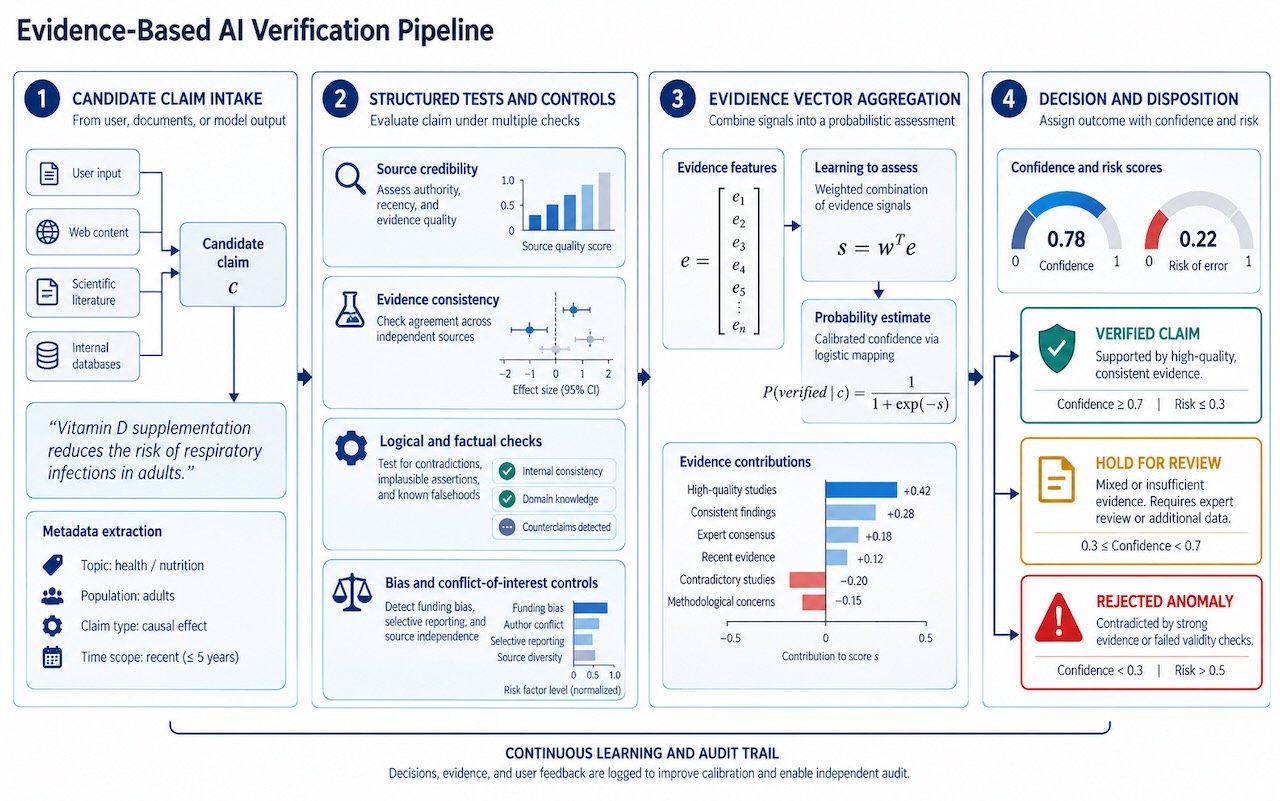
The conflict inside modern AI systems
Most AI workflows combine several roles inside one model or one orchestration layer: generate an answer, critique it, revise it, and finally declare it acceptable. That can improve quality, but it is not the same thing as independent verification.
If the same reasoning process creates both the hypothesis and the evidence for the hypothesis, circular authority can emerge.
The problem becomes more important as agents gain tools and permissions. A mistaken paragraph is inconvenient. A mistaken action executed against a real system can be consequential.
What independence means
Independence does not require a mystical perfect verifier. It requires structural separation.
In an assurance architecture, the system that proposes an answer should not be able to silently rewrite the test, alter the evidence, weaken the threshold, or redefine success after seeing the result.
That is why an evidence-first process benefits from frozen inputs, preregistered tests, independent execution, preserved artifacts, and explicit adjudication rules.
The point is not bureaucracy. The point is preventing the answer from controlling the exam.
Falsification before celebration
A useful AI assurance system should actively search for reasons a claim may be wrong.
That means testing edge cases, negative controls, alternative explanations, duplicate mechanisms, environmental failures, and contradictory evidence.
When the evidence survives those attempts, confidence can increase. When it does not, the system should preserve the failure rather than tuning around it.
Why provenance matters
Every important claim should have a path back to the evidence that supports it.
For AI systems, that means preserving enough information to reconstruct what happened: the input, model or system state, test conditions, raw outputs, timestamps, hashes where appropriate, decision rules, and the final epistemic classification.
Without provenance, a result may be impressive but difficult to audit. With provenance, another evaluator can inspect the path from observation to conclusion.
The value of bounded claims
One of the most damaging habits in technology is allowing a narrow success to expand into a broad narrative.
A model succeeding on one benchmark does not prove general intelligence. A security mechanism working in one environment does not prove it is universal. An agent completing one workflow does not prove it can operate safely across every workflow.
Arithmetic Assurance therefore treats claim boundaries as first-class objects.
The question is not only, “Did this work?” It is also, “Exactly what does this result establish, under which conditions, and what remains unproven?”
Preserving negative results
Scientific systems become fragile when they are optimized to produce only positive outcomes.
A robust assurance program must allow REFUTED, CONFLICTED, UNKNOWN, and INFRA_FAILURE to survive as legitimate states.
That creates an incentive structure where the system is rewarded for accurately describing reality rather than for producing a preferred narrative.
Where this matters
Independent verification becomes increasingly important in autonomous agents, enterprise AI, cybersecurity, scientific reasoning, compliance workflows, financial decisions, and any environment where AI-generated outputs influence consequential action.
It also matters in Alexandria. The city’s commercial, discovery, and human-interface layers should never be able to rewrite the scientific conclusions produced by its assurance layer.
That separation is intentional.
The broader principle
As AI systems become more capable, assurance should become more structural.
We should not ask powerful systems to be less capable. We should build institutions around them that make capability auditable, bounded, and accountable.
Generation should be creative. Verification should be conservative.
That is the role Arithmetic Assurance is intended to explore.
Evidence and standards context
NIST’s AI RMF provides direct support for independent assessment: its Measure function calls for objective, repeatable TEVV processes and notes that internal experts who were not front-line developers and/or independent assessors should participate in regular assessments. The associated Playbook recommends separate testing teams and asks organizations to assess the independence and stature of TEVV and oversight actors. Arithmetic Assurance is an experimental architecture motivated by this same separation-of-roles problem; it is not presented here as a NIST-endorsed implementation.
Selected sources: NIST AI RMF Core · NIST AI RMF Playbook — Measure · NIST TEVV-Athlon Framework
Explore: Arithmetic Assurance / BUBi · AI Research & Governance · Alexandria
Working on AI assurance, evaluation, governance, or autonomous systems? Contact David Ramirez.