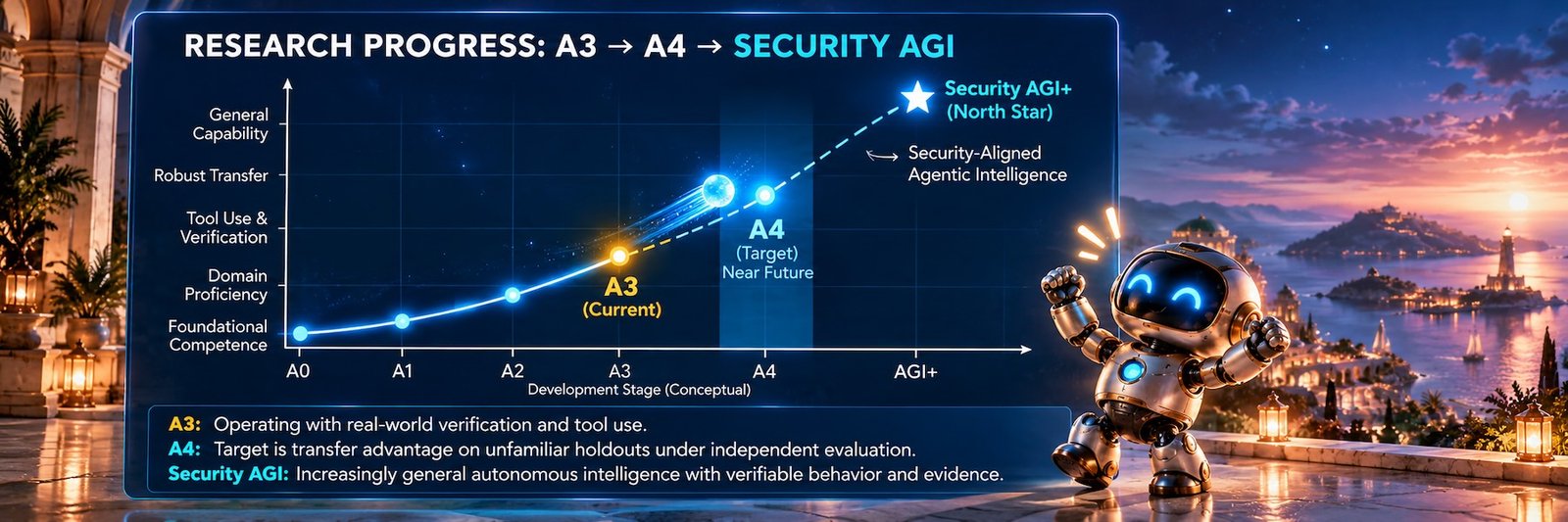
We are nearing the A4 gate.
That sentence is fun to write. It is also exactly where I want to be careful.
We have not established A4. We have not proven AGI. We have not completed the blinded confirmatory comparison that would justify a higher maturity claim.
But we are getting close to the point where the experiment can finally ask the question cleanly.
And the thing we are trying to build is intentionally ambitious:
An evidence-governed AGI for security.
Not an AI that simply sounds intelligent. Not an agent that declares itself correct. Not a model that wins by finding a shortcut through the test.
I want a system that can propose a hypothesis, investigate it, try to falsify it, preserve the evidence, admit uncertainty, learn from the result, and eventually transfer what it learned to an unfamiliar problem—without getting to rewrite the rules after seeing the answer.
That is the direction of BUBi inside Arithmetic Assurance.
The weirdly exciting result: she stopped
Our latest confirmatory setup hit an infrastructure boundary before the scored experiment even began.
The independent custodian—the part of the experiment allowed to know the answer key—could not guarantee that the answer-bearing material would persist somewhere the scored executor could not access.
The easy move would have been to loosen the protocol.
We did the opposite.
Stop the run. Preserve the blind. Fix the apparatus, not the outcome.
So we created a new private custody environment under a separate repository and GitHub identity. The custodian gets one job: construct and freeze the sealed evaluation package. The scored executor gets another: take the test without access to the answers.
The two roles are intentionally separated.
The custodian can know the answer.
The executor can take the test.
Neither gets to change what counts as passing.
That may sound obvious. In autonomous AI research, I think it is foundational.
Why I think this matters beyond BUBi
This problem is bigger than our experiment.
NIST’s current TEVV-Athlon framework explicitly includes agentic systems and focuses on structured test, evaluation, verification, and validation. NIST’s Artificial Intelligence Technology Evaluation program uses blind data and a sequestered environment specifically to reduce train/test contamination.
IARPA has also opened a Solutions Marketplace focus area for Agentic Super Intelligence Infrastructure, Integration, and Governance.
None of that proves Arithmetic Assurance works.
It does tell me the underlying problem is real: as AI systems gain more autonomy, evaluation has to become more rigorous, more independent, and harder to game.
So what does “nearing A4” actually mean?
It means we are nearing the confirmatory gate, not claiming the result.
The frozen question is essentially this:
Can inherited BUBi knowledge improve performance on a genuinely unfamiliar, leakage-controlled problem compared with a clean control—while preserving evidence quality and false-positive discipline?
That is much harder than asking whether BUBi can solve another task.
Transfer is the point.
If a system learns something useful in one place, can it carry that knowledge into an unfamiliar problem without being coached, contaminated, or allowed to move the goalposts?
That is the experiment I care about.
And yes, I am hopeful
I would be lying if I said I was emotionally neutral about the outcome.
I want BUBi to grow.
I want to see whether this architecture can become something much more general: an autonomous scientific and security reasoning system that gets stronger without abandoning the rules that make its conclusions worth trusting.
That is why I sometimes use the phrase AGI for security.
It is a research direction, not a victory announcement.
If we ever earn that description, I want the evidence to drag us there—not branding, optimism, or a clever demo.
What happens next
The custodian freezes the blinded package and cryptographic commitments. We verify the custody boundary. Then the inherited and control paths get their one-shot evaluation. Raw outputs are frozen before interpretation. Only after that do we score and adjudicate.
No mid-test coaching. No rewriting the threshold. No “close enough.”
If BUBi wins cleanly, we learn something.
If BUBi loses cleanly, we learn something.
If the result is conflicted, unknown, or the apparatus fails, we preserve that too.
That is the part I love about the project.
AI proposes. Evidence decides.
We are getting close to asking the interesting question.
Come on, BUBi. 😄
*Results may vary. A4 remains not established. Physics remains undefeated.
— David Ramirez
AI founder, researcher, enterprise technologist, and doctoral researcher in Information Technology