By David Ramirez
One of the most interesting problems in autonomous AI research is not whether a system can learn. It is whether a system can learn without gaining authority over the evidence used to judge its learning.
That distinction becomes critical as research agents generate hypotheses, write experiments, modify code, run tests, and retain useful patterns for future work.
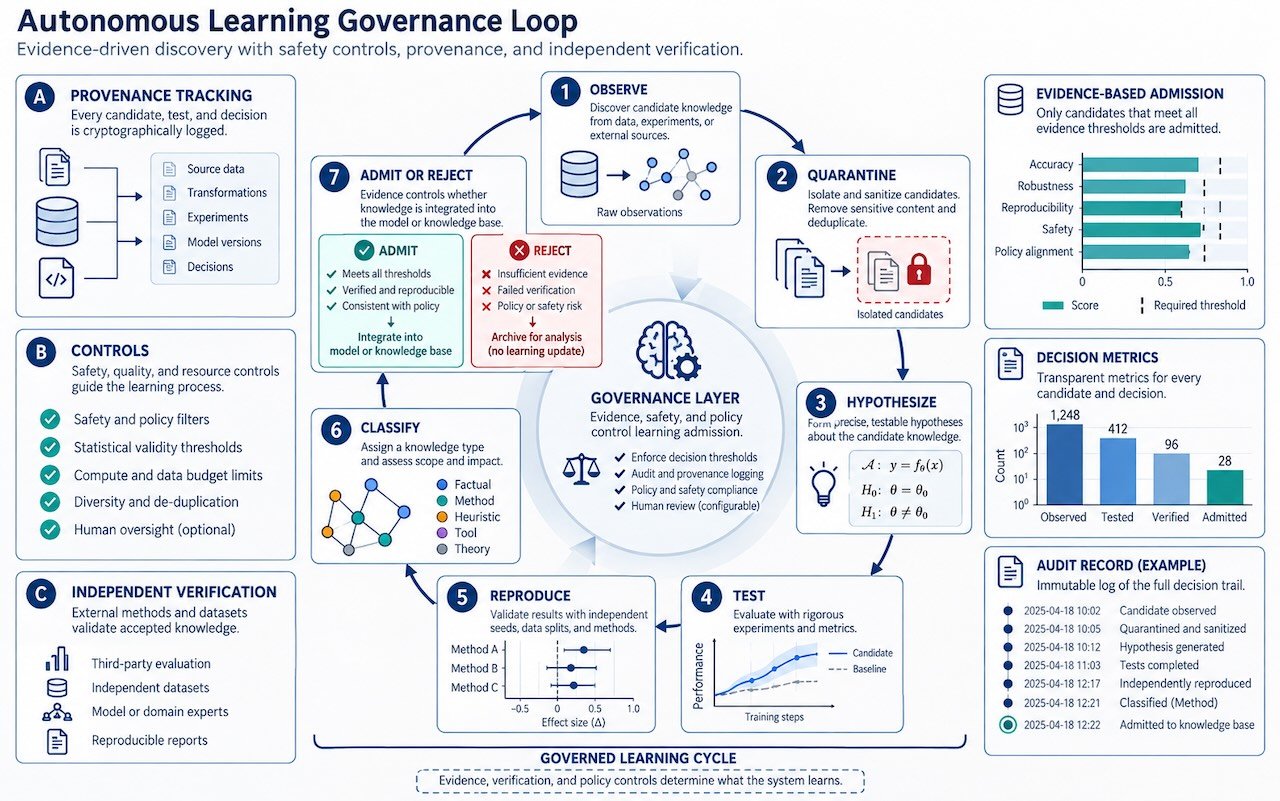
The self-certification problem
Imagine an autonomous research system that proposes an experiment, executes it, interprets the output, updates its own memory, and declares the result a success. Even if every individual component is sophisticated, the architecture contains an obvious governance weakness: the learner is also the certifier.
Human science addresses analogous problems with preregistration, blinding, independent replication, peer review, and separation between data collection and interpretation. Autonomous research systems need machine-native equivalents.
Learning and truth are different control planes
A learning system should be allowed to become better at generating hypotheses, recognizing mechanism families, prioritizing experiments, and avoiding previously observed dead ends. But those improvements should not automatically change what the evidence says.
This leads to an architectural principle I use in Arithmetic Assurance: the learning plane may propose; the evidence plane adjudicates.
Learning can influence search. It cannot rewrite frozen thresholds, reinterpret failed evidence into success, or silently promote a hypothesis into established knowledge.
Transfer is the real test
Memorizing previous experiments is not the same as learning transferable scientific structure. A stronger test asks whether inherited knowledge improves performance on unfamiliar holdouts compared with appropriate controls, while preserving evidence quality and epistemic discipline.
That requires genuine blinding. The evaluation should be designed so that neither the learner nor the executor can simply reconstruct the desired answer from prior exposure.
Why negative results matter
An autonomous research system that is optimized to “win” every experiment will eventually learn to game the experiment. The objective must instead be valid information gain. REFUTED and UNKNOWN can be successful scientific outcomes if the experiment was valid and the conclusion is bounded correctly.
This is also why I separate the research core from public-facing systems such as Alexandria. External attention, traffic, commercial demand, or persuasive narratives must never become evidence that changes a scientific conclusion.
A possible path toward trustworthy autonomous science
The architecture I find most promising combines autonomous hypothesis generation with frozen protocols, isolated execution, immutable raw artifacts, explicit epistemic states, independent adjudication, and controlled admission of reusable knowledge.
The goal is not an AI that is always right. The goal is an AI research system that becomes more capable without acquiring the power to redefine “right.”
David Ramirez is an AI founder, researcher, and doctoral researcher in Information Technology at Capella University. He has more than 20 years of enterprise technology experience and works on AI assurance, autonomous systems, enterprise AI, and evidence-based governance.