Why I’m Building Execution Custody for Autonomous AI
The future does not need less autonomous intelligence. It needs a stronger boundary between an AI system that recommends an action and an institution that authorizes the consequence.
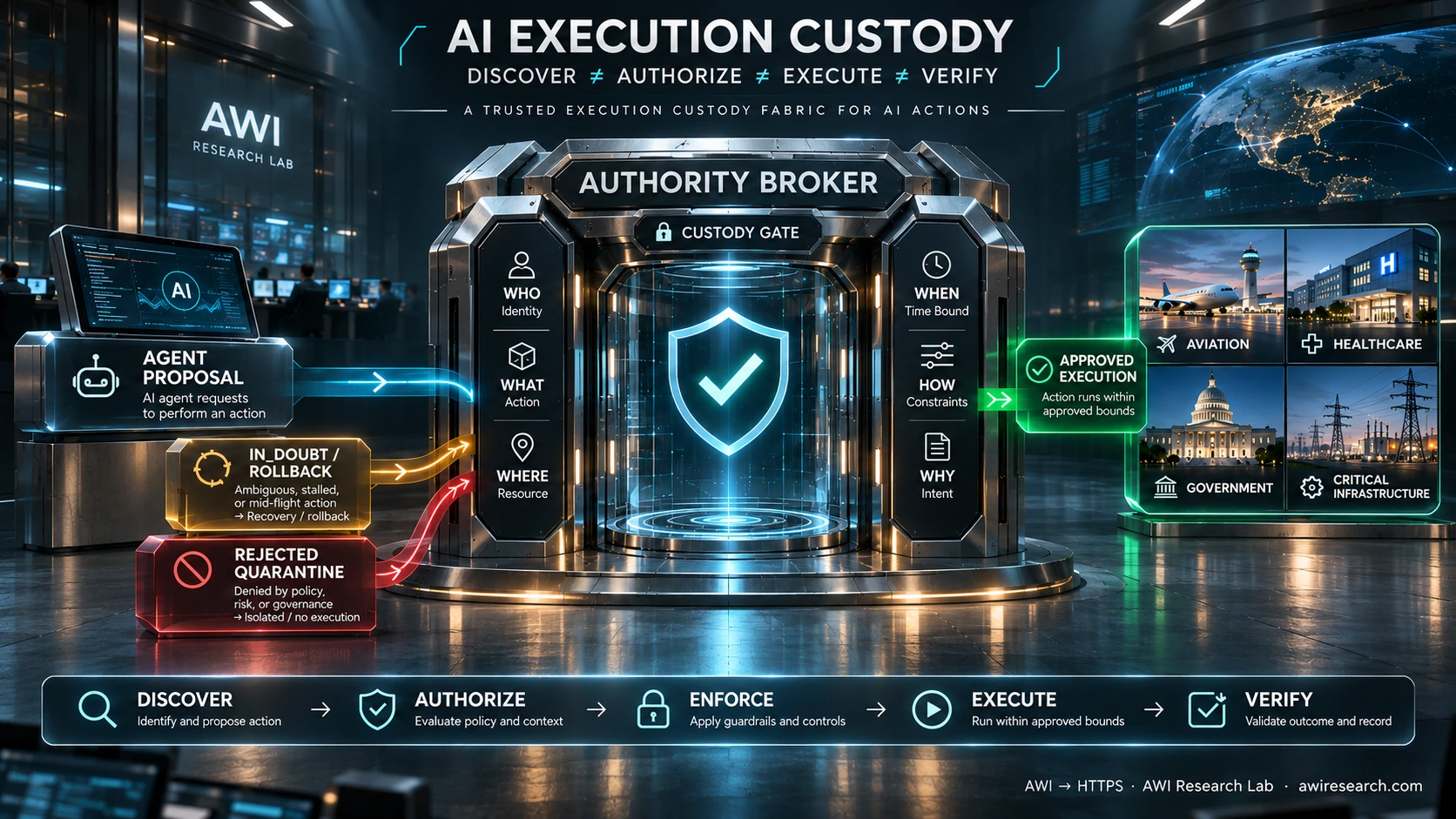
I have spent much of my professional life working where technology, operations, and executive decision-making meet. I have seen the pressure to automate a workflow before its owner can clearly explain the permissions, dependencies, and recovery obligations that come with it. The fastest dashboard in the world does not help when a bad action becomes irreversible before someone can verify who authorized it.
The November 12–17 infrastructure disruptions made that problem impossible to ignore. Microsoft 365, FAA systems, Workday, banking, United Airlines, NSA networks, and Apple services experienced separately reported failures. They were not one proven coordinated attack. That is precisely why I find the pattern so important: routine dependencies, changes, and recovery paths can fail without an adversary controlling the event. AWI Research Lab documents the source record here.
My argument begins where today's agent demos end.
Autonomous AI is about to make software changes, route transactions, configure equipment, move data, and intervene in business processes at machine speed. A language model may identify a plausible repair. A vendor credential may prove that a service account exists. Neither of those facts establishes the authority to execute a particular effect against a live system.
I call the missing institutional boundary AI Execution Custody. AWI Research Lab's new category pillar defines it in full: discovery and proposal are separate from scoped, revocable authorization; execution is tied to durable intent; uncertain results move into explicit recovery; evidence is independently held. That is the architecture we are building through AWI → HTTPS.
Four responsibilities. Four separations.
An agent may discover a service or node without acquiring the right to operate it. Discoverability is not a permission model.
Identity, ownership, tenant scope, expiration, revocation, and the concrete requested action must be checked independently of the requesting model.
Independent detection and controlled execution must preserve auditability, including during failed commits, crashes, and ambiguous results.
An agent cannot be both the party initiating an effect and the sole witness declaring that effect lawful and successful.
The opportunity is bigger than the risk.
There is an optimistic reason I am building this. When the web gained cryptographic transport guarantees, businesses no longer had to treat every online financial exchange as a leap of faith. Autonomous systems need an equivalent discipline at the action boundary. If institutions can know exactly what an agent may change—and how they will prove what happened after a fault—they can expand automation into complex environments without surrendering governance.
Imagine the operational gain for construction, aviation, healthcare, critical research, and financial services: an assistant can identify a fault and prepare a proposed intervention immediately, while an independently administered authority decides whether the intervention is permitted. That is not bureaucracy for its own sake. It is the route to autonomy worth trusting.
Test our thinking rather than accepting a slogan.
AWI Research Lab has published an interactive 68-assertion security sandbox, technical research on AWI → HTTPS and Lighthouse, and a public Lean 4 authorization model. The objective is to replace unexamined confidence with precise, challengeable engineering evidence.
The enduring question I want CISOs, scientists, government evaluators, and product leaders to ask is simple: who can authorize the next machine-speed action, and who can independently prove what happened?
AI PROPOSES.
EVIDENCE DECIDES.
We are not an app. We are building the HTTPS-equivalent trust layer for autonomous AI.
READ THE AI EXECUTION CUSTODY PILLAR ↗
Explore the 68-assertion demo ↗
— David Ramirez
Founder & Principal Research Investigator, AWI Research Lab