By David Ramirez
The agent age has a trust problem. We are giving software more power faster than we are improving the evidence required to justify that power.
A model can be wrong and sound confident. An autonomous agent can be wrong and act on the error. It can call tools, modify state, contact services, write code, move through workflows, and produce a final result that looks clean even when the path underneath it was not.
That is why I think AI assurance needs a sharper definition.
AI assurance is not a promise
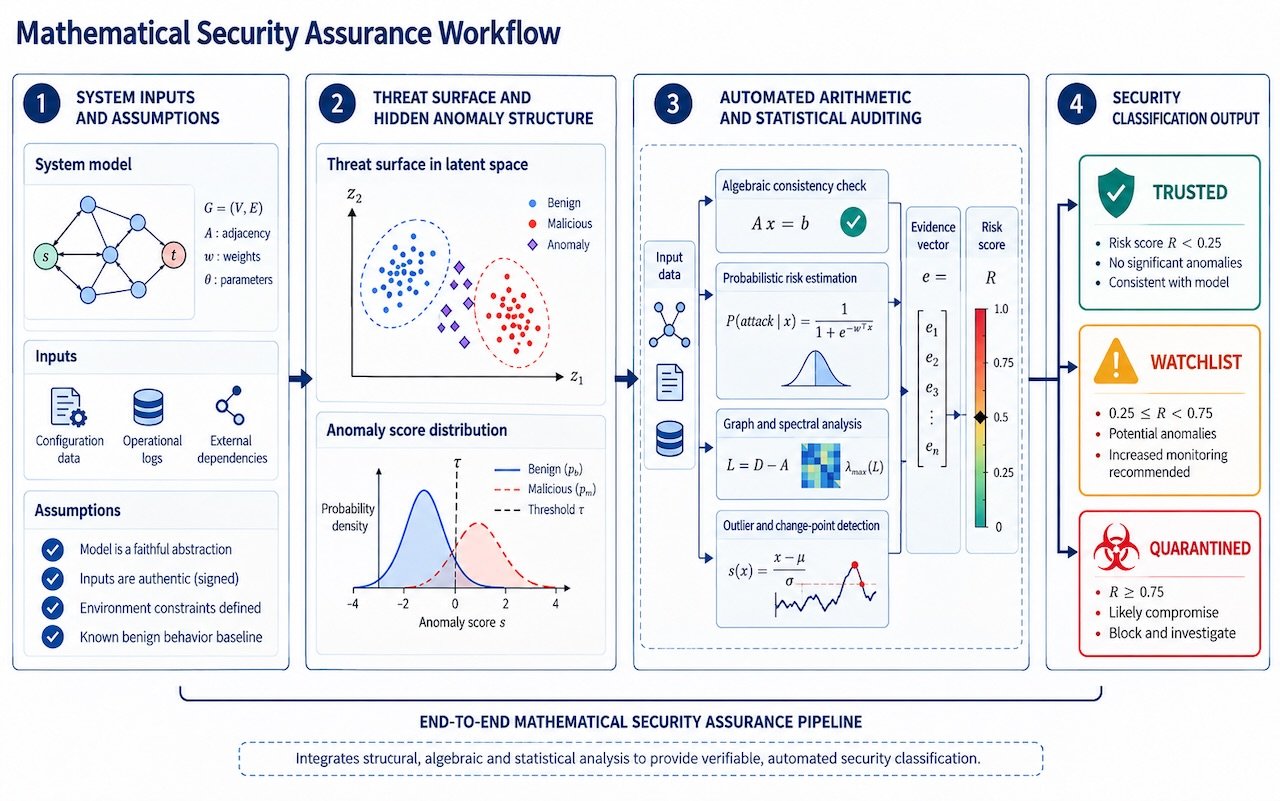
For me, AI assurance is the engineering discipline of turning claims about an AI system into evidence-bearing conclusions that another evaluator can inspect, challenge, reproduce, and bound.
The word bounded matters. A test does not prove that a system is universally safe, reliable, or intelligent. It can only establish something inside the conditions that were actually tested.
NIST’s Test, Evaluation, Verification, and Validation work makes the same broader point: useful evaluation has to be connected to objectives, context, measurement, and evidence rather than reduced to a single impressive number. NIST TEVV-Athlon
Capability is not evidence
This distinction is easy to lose in AI because demonstrations are persuasive. If an agent completes a task once, we have evidence that it completed that task once. We do not automatically have evidence of robustness, transfer, reliability, security, or general capability.
The stronger question is:
What did the system actually demonstrate, under what conditions, and what evidence rules out the obvious alternative explanations?
That question is the center of my work on Arithmetic Assurance / BUBi.
A practical assurance loop
That loop needs more than a benchmark score. I use Testing, Evaluation, Verification, and Validation (TEVV) for AI agents to separate what was tested, how performance was measured, whether requirements were satisfied, and whether the system fits its intended use.
I use a simple structure:
- Freeze the claim. State what is being tested before looking at the outcome.
- Freeze the boundary. Record the model, tools, data, permissions, environment, thresholds, stopping rules, and allowed retries.
- Run an independent check. Do not let the system that generated the claim quietly redefine what counts as proof.
- Preserve the raw evidence. Logs, artifacts, traces, hashes, controls, and failures should survive interpretation.
- Classify honestly. A useful result set includes SUPPORTED, REFUTED, CONFLICTED, and UNKNOWN.
- State what is not established. The limitation is part of the result, not a disclaimer added at the end.
This is the logic behind the operating doctrine I use across the research: AI proposes. Evidence decides.
Why UNKNOWN is a feature
A system optimized to always produce a positive answer will eventually learn to game the evaluation. Science works differently. Sometimes the correct conclusion is that the evidence is insufficient.
UNKNOWN is useful because it tells us exactly where the measurement boundary is. It gives us the next experiment. It prevents narrative from outrunning reality.
That matters even more when the system being evaluated is capable of changing its own workflow, selecting tools, or learning from prior attempts.
Assurance becomes more important as autonomy increases
Traditional model evaluation often focuses on outputs. Agentic systems add another layer: process.
Did the agent use the authorized tool? Did it remain inside scope? Did it access data it was allowed to access? Did it retry after a failure? Did it silently change an intermediate artifact? Did a human approve the consequential step? Could an independent evaluator reconstruct what happened?
Once AI systems act, those questions stop being optional governance language. They become engineering requirements.
This is why my work on machine-readable evidence and audit trails treats provenance as infrastructure rather than documentation.
Assurance is not the same as safety or compliance
Safety, compliance, and assurance overlap, but they are not interchangeable.
Safety asks whether harms are acceptably controlled. Compliance asks whether requirements are met. Assurance asks whether the evidence justifies the claim being made.
A system can comply with a process and still perform badly. A system can perform well and still lack enough evidence for a high-consequence deployment. Assurance is the discipline that keeps those distinctions visible.
The opportunity
I think justified confidence will become one of the scarce resources of the agent economy.
The organizations that can prove what their systems did, what they were allowed to do, what evidence supports the outcome, and where uncertainty remains will be able to delegate more useful work than organizations relying on persuasive demos and hope.
The goal is not to make AI sound cautious. The goal is to build systems whose claims can survive contact with evidence.
In the agent age, trust should be earned at machine speed.
That is the problem I am trying to solve.
David Ramirez is an AI founder, researcher, and doctoral researcher in Information Technology at Capella University. He has more than 20 years of enterprise technology experience and works on AI assurance, autonomous systems, enterprise AI, and evidence-based governance.